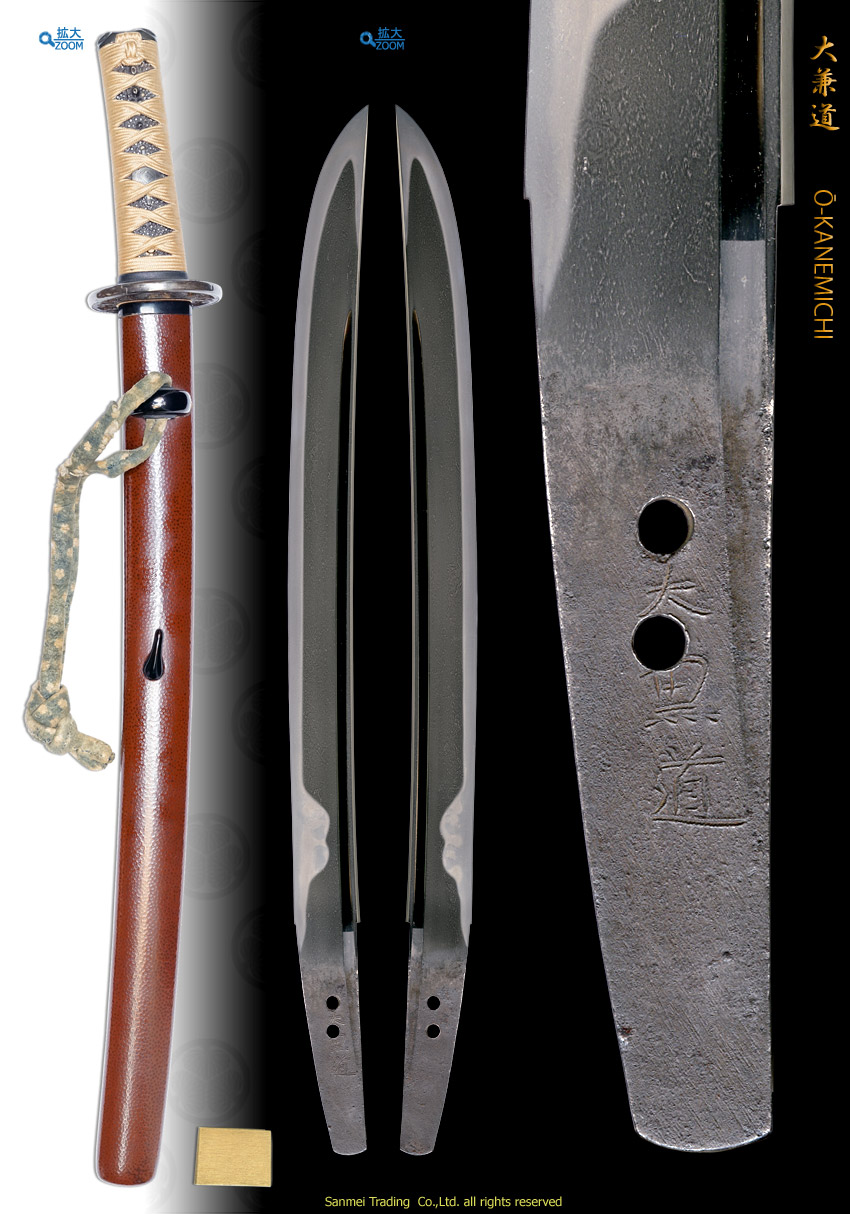
with)Brown Rapeseed pattern scabbard Owari-style Wakizashi Koshirae
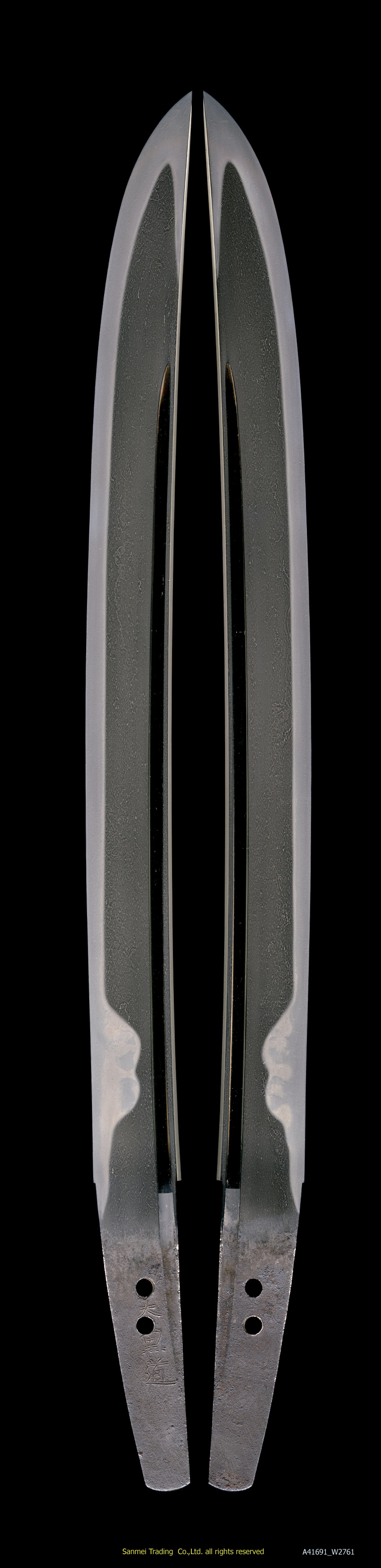
Length of cutting edge37.7cm Curvature0.5cm Thickness of base5.6mm
Forging(Hada): Forging is refined Itame mixing with Mokume ware where delicate pattern is closingly forged and surface is covered with sparkling Ni-nie that generates darkish, delicate Nie lines along wooden grain so called CHIKEI activity. Quench starting area appears slanting diffused reflection "Utsuri" toward back ridge.
Temper(Hamon): Temper starts with a slight slope "Yakidashi" upper the Hamachi, a small Gunome, a pair of large/tall Gunome whose middle is narrow and again repeats a small Gunome connecting to middle straight Hamon "Suguha". Sparkling uniform Nie accumulates on the gorges of large Gunome-outline where shows short lines of Nie "Sunagashi" activity, upper area of Suguha quench is relatively tight and vividly bright with sparkling Nie. The interior of temper is full of bright "Nioi" mist. The entire temper gives off the impression of dignified manner.
Temper of tip(Boshi): Temper of tip has slightly wavy indication, medium circle gently turns deeply back.
Tang(Nakago): Nakago is in UBU original. Checked (Higaki) file marks. Two peg holes (upper is an original). Double-bevelled (Kurijiri) heel shape. Back ridge of Nakago is flat. The signature in front is thin chiselled three character that reads Ō-KANEMICHI 大兼道.
KANEMICHI 兼道 (later changed to DAIDŌ 大道) has been said as "the 9th generation of Shizu-saburo KANEUJI 志津三郎兼氏" has been renowned as the most superior maker who equals to KANETSUNE 兼常 and KANEFUSA 兼房 in Mino domain. His posthumous works signed KANEMICHI 兼道 with the date of year ranges from Tenbun 16 (1547) to Eiroku 5 (1562).
From the reference of DAIDŌ-KI 大道記, he offered the dagger to Emperor Ōgimachi 正親町天皇 on Eiroku 12, Spring (1569) and was granted a word of Ō 大 with the Emperor and official district Mutsunokami 陸奥守 title by the Imperial Court. He had put a honor word of Ō 大 prefixed to his smith name to be Ō-KANEMICHI 大兼道 only a couple of years during Genki era (1570-72) and then put an official title "Mutsunokami" 陸奥守 and changed his smith name as "DAIDO" 大道 on after Tensho 1 (1573). The posthumous works with the date of year as the inscription of Mutsunokami DAIDO 陸奥守大道 ranges from Tensho 1 - 19 (1573-91).
The places of his studio, initially was in Seki town and later had moved to Gifu and he finally concluded to Kyoto as the founder of Mishina school during Bunrokuk era (1592-95) with his four sons Iganokami KINMICHI 伊賀守金道, Rai KINMICHI 来金道, Tanbanokami YOSHIMICHI 丹波守吉道 and Echunokami MASATOSHI 越中守正俊.
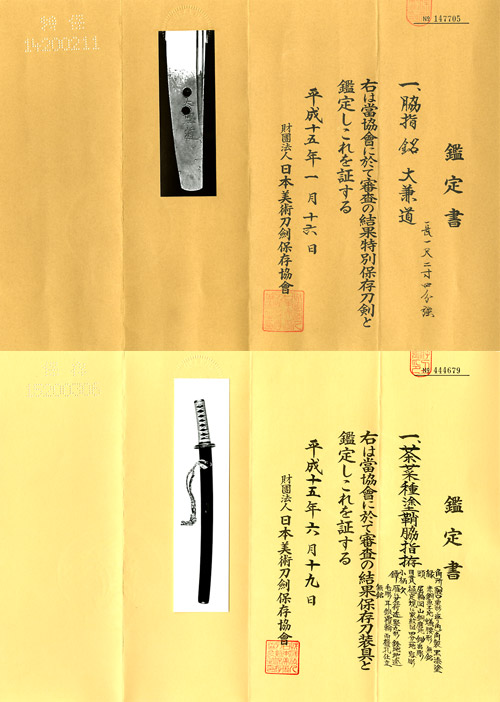
The subject wakizashi shows the noble dignity during Azuchi-Momoyama period and won the prize of Tokubetsu Hozon judgement. Also it is quite rare to come across his posthumous works with the inscription of Ō-KANEMICHI 大兼道 (would be only a few existing) of the top research material value.
An original (Edo period) Owari style brown Rapeseed pattern scabbard Wakizashi koshirae consists of : (click HERE for higher ersolution images for each metal fitting)
- Water buffalo horn Koikuchi, Kurikata and Kaeri-tsuno black lacquered
- Fuchi : Shakudo Nanako-ji surface, Ant-waist shape unsigned
- Kashira : Yamagane polish surface, a design of Bit "Kutsuwa"
- Menuki : Shibuichi Yobori carving, a design of Scacle with Family crest
- Kozuka : missing
- Tsuka/hilt : Black lacquered rayskin, brown-gold silk cord wrap
- Tsuba : Iron ground openwork, Silver Fukurin rim, a design of Clock, Wild geese and Japanese ginger
- Sageo/strap : Cherryblossoms pattern, smoked deer skin
- Seppa : Copper/gold foiled Owari-style
- Habaki : Copper/gold foiled contemporary made which is designed for Shira-saya plain wood mounting)
Recent top quality polish/Condition scale: mint-excellent (using a scale of mint-excellent-very good-good-fair-poor).
reference data:
Suzuki Takuo/Sugiura Yoshiyuki Muromachi-ki Mino Toko-no Kenkyu Ribun Shuppan 2006