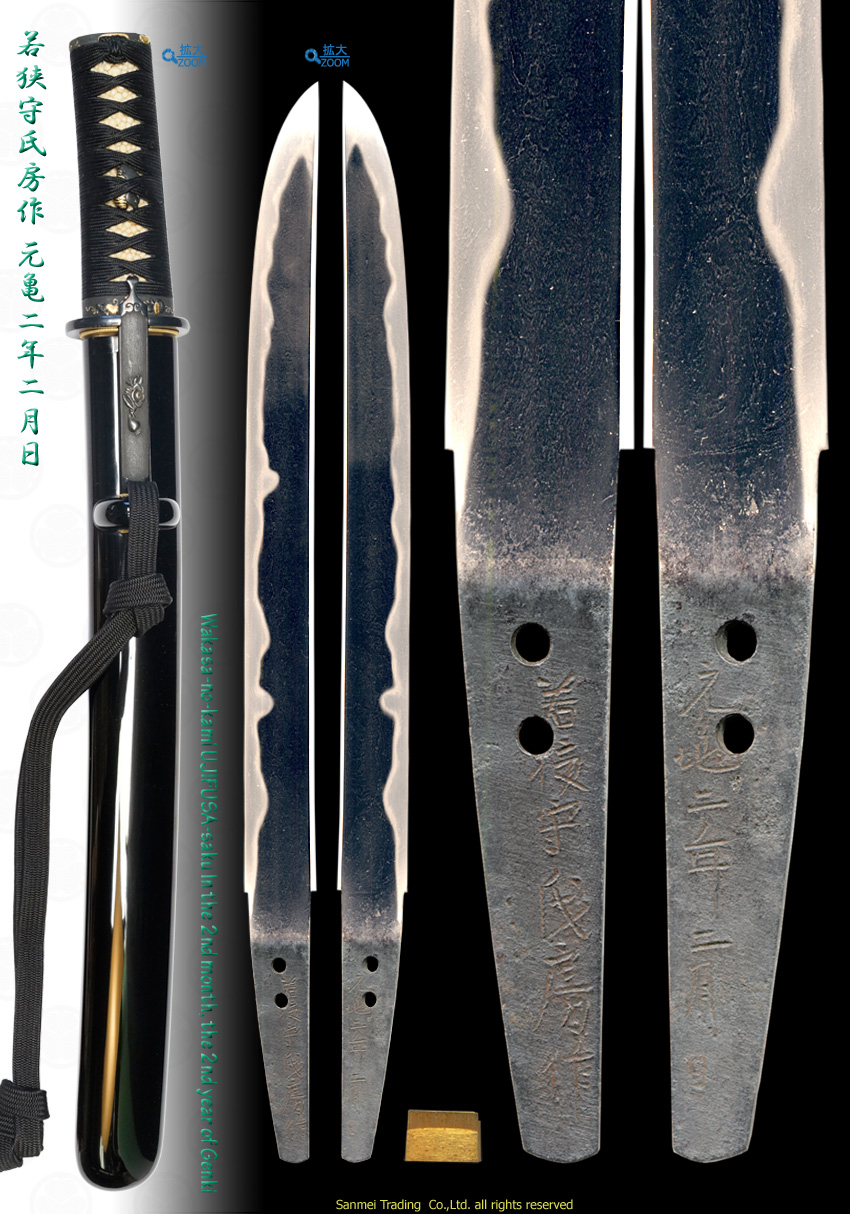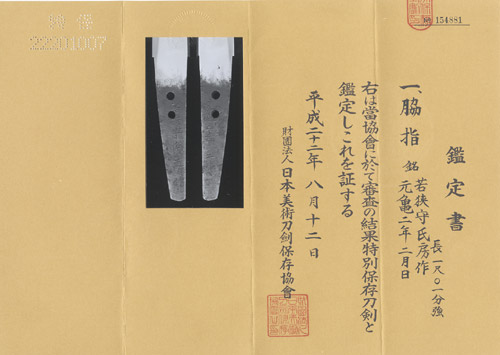
Length of cutting edge30.8cm Curvature0.2cm Width of base30.8mm Thickness of base5.4mm
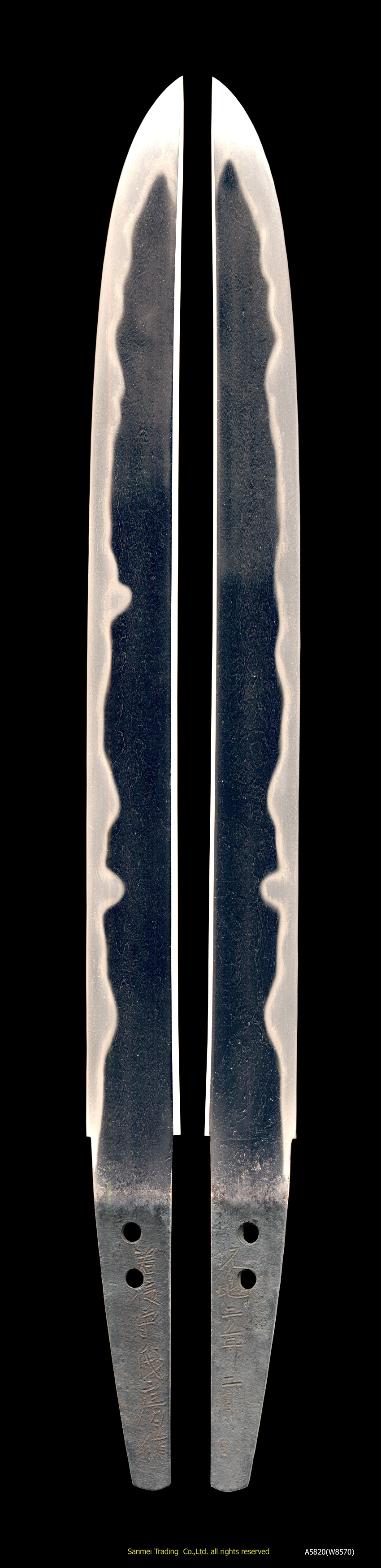
Forging(Hada): Forging is conspicuous Itame mixing with entwined flowing Masame partly. The surface shows moistened beauty impression. Steel is darkish blue with fine Nie sparkling glitter and mottled Utsuri reflection in upper Hira-ji surface.
Temper(Hamon): Hamon is fine Nie hard metal granules base, wavy Notare and Clove outline. The entire temper shape of both sides are well matched. The summit of Clove outline radiates sparkling, mottled reflection into the Hiraji surface.
Temper of tip(Boshi): Boshi is irregularly Midarekomi with medium circle, Hakikake blush indication then deeply turns back that generates side view of Jizou stone stature.
Tang(Nakago): Nakago is in UBU original. Two peg holes. Sujikai (slanting left) filemarks. Back ridge of Nakago is flat and Kurijiri round heel shape. The signature in front is six large character that reads Wakasa-no-kami UJIFUSA-saku 若狭守氏房作 and the reversed side is chiselled with the date of year In the 2nd month, the 2nd year of Genki (1571) 元亀二年二月日.
The first smith UJIFUSA, real name [Kawamura Kyouzaburo, the initial smith name KANEFUSA], was born in the 3rd year of Tenbun (1534) as the 3rd son of Seizaemon KANEFUSA in Gifu, Mino province. He officially was given the way of legitimate son of KANEFUSA from his elder brother Iwami-no-kami KUNIFUSA in the 2nd year of Kouji (1556) to chage his given name from Kyouzabuto to Seizaemon then moved to Seki town, Mino province.
In the 19th day, the 4th month, 13th year of Eiroku (1570) he enjoyed the official title of [Kiyozaemon-no-shuoi] and changed his smith name to UJIFUSA, then 3 days later he got an official district [Wakasa-no-kami] title granted by the Imperial Court.
He won the praise from the daimyo Oda Nobunaga to exclusively belong to him. In the 5th year of Tensho (1577) he moved to Azuchi castle town in Oumi province along with Oda Nobunaga to work exclusively as a vassal.
After the Incident at Honnō-ji (本能寺の変, Honnō-ji no Hen) referred to the forced suicide in the 21th day, the sixth month, the 10th year of Tensho (1582) of Oda Nobunaga, UJIFUSA returned to his home town Gifu with Oda Nobutaka's help then again came back to Kiyosu castle town under support of Sakuma Masakatsu. He passed away in the 11th day, the 5th month of Tensho (1590) at 57.
This is the work in Genki 2 (1571) when UJIFUSA was 38 years old, in the peak of Warning States period while Oda Nobunaga decided crucial battle of ANEGAWA, Ishiyama Hongan-ji War and Siege of Mount Hiei. The top three character of WAKASA-no-KAMI 若狭守 is smaller and the rest for smith name UJI FUSA-saku 氏房作 are larger, that is one of his peculiar manner in his prime days. This Sun-nobi style Tanto is his lifework which was made upon special demand from daimyo Oda Nobunaga himself or his vassal general Samurai in Owari domain then have been treasured in generations. Nakago holds a good taste of patina, remains clear filemark and chisel of signature. Ujifusa praised as Waza-mono (the best cutting performance).
Gold foiled double habaki collar, preserved in Shira-Saya plain wood mounting.
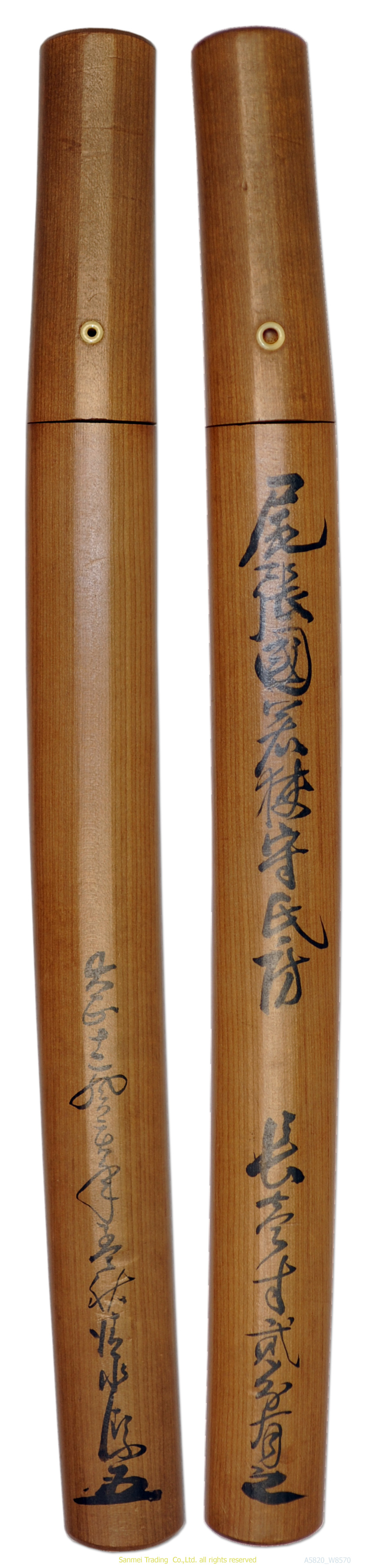
Recent elaborate polish/Condition scale: excellent (using a scale of mint-excellent-very good-good-fair-poor).
reference sword: Katana signed Wakasa-no-kami UJIFUSA-saku The 8th month, 2nd year of Genki (1571)
reference data:[Owari Tōkōfu] Iwata Atou 1985 Publisher : Nagoya city Board of Education