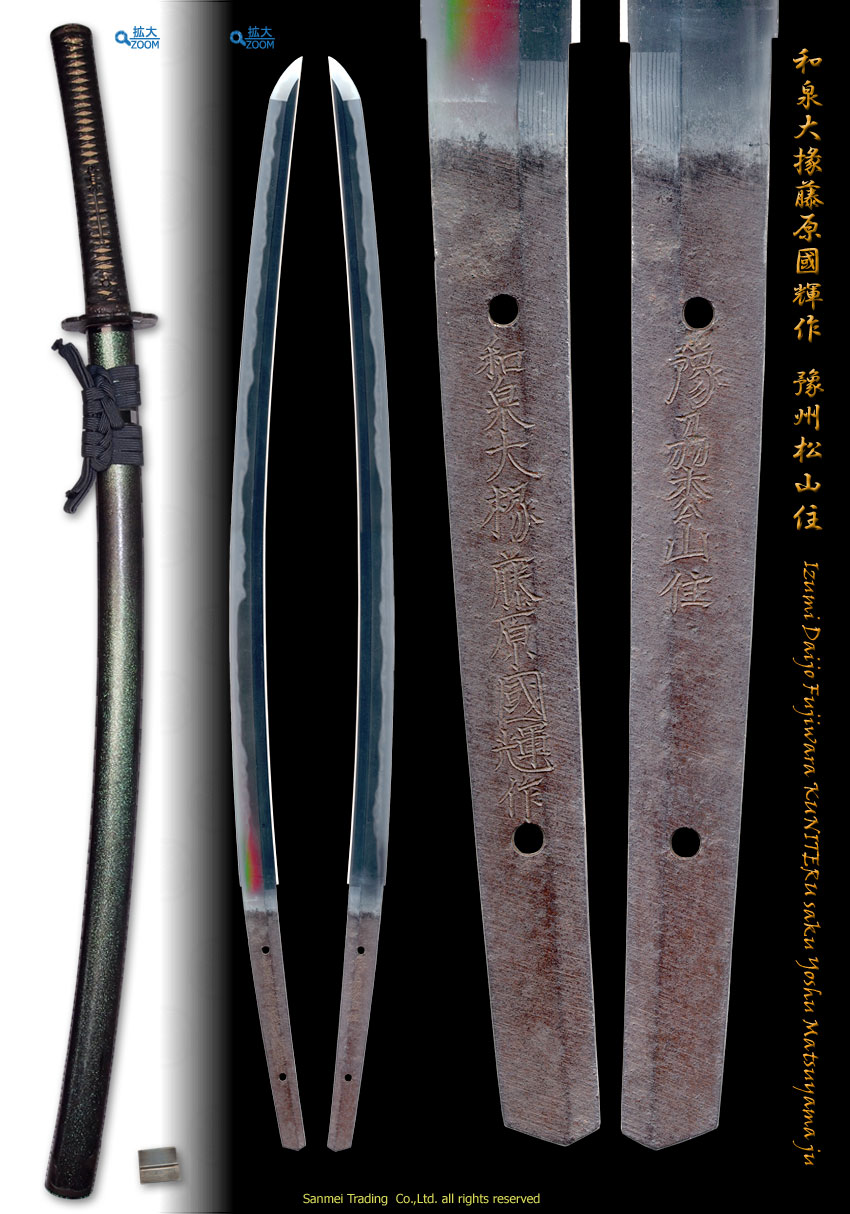
Yoshu Matsuyama-ju
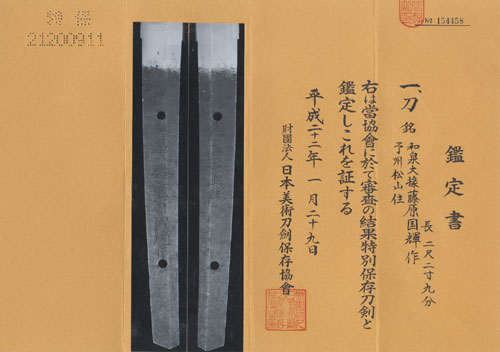
with) Blue pearl of inlay scabbard Uchigatana Koshirae
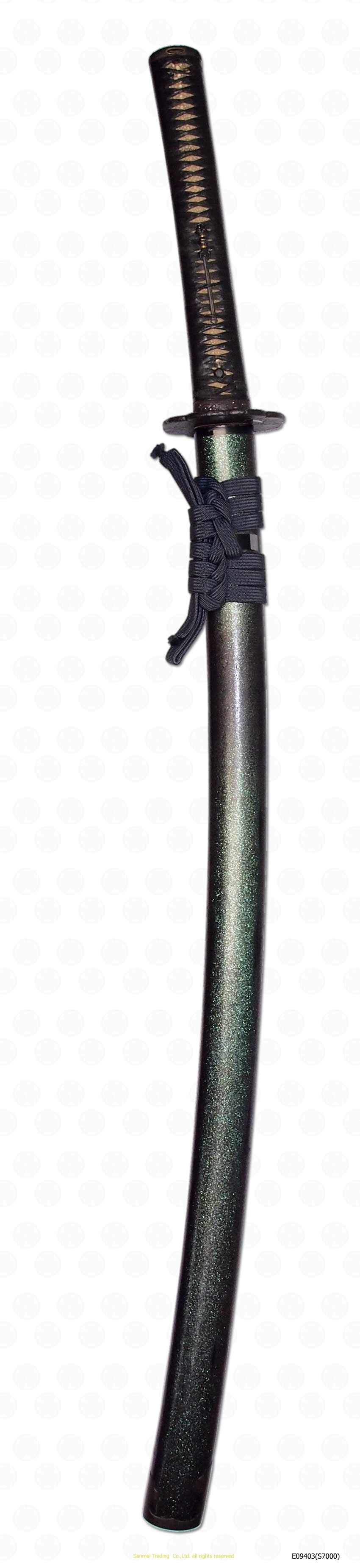
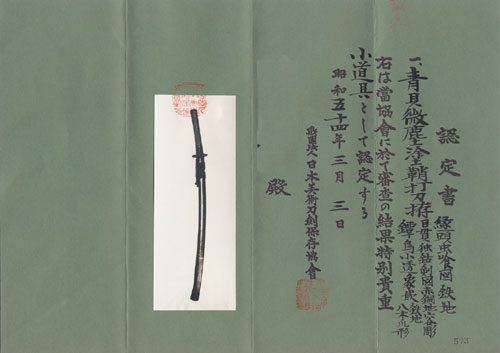
NBTHK(Tokubetsu Kicho Kodougu)
Length of cutting edge 69.3cm Curvature 1.6cm Width of base 32.2mm Width of Yokote 23.5mm Thickness of base 7.3mm
Kitae(forging pattern) : Kitae-hada is fine Itame-hada (wooden grain) generally mixing in with large Mokume (burl grain) marks, of which Hiraji surface is covered in speckled ji-nie that generates darkish precise Nie lines so called CHIKEI activity.
Hamon(tempering pattern) : Hamon starts with straight Suguha to form Yakidashi then wavy Notare, mixture of small clove, zigzag and some temper splash spilled on surface (Tobiyaki). From upper middle of the blade, wider the temper that create long foot clove Choji-ha, stronger the Nie, deeper the Nioi activity. Long clove foot frequently works and bright Kinsen or Sunagashi activity streams across the feet. The entire temper is vividly clear, full of bright Nie activity, gaily decorated.
Boshi (tip): The temper of tip is Midarekomi irregular lines with two gunome midare the medium circle turns back.
Nakago(tang) : Original UBU with two mekugi-ana retaining holes. Kattesagari (slightly slanting leftward) file marks. Iriyama (V-shape) heel. The signature in front is long character that starts from the title Izumi-Daijo, clan Fujiwara then smith name KUNITERU-saku, the reversed side is chiselled the place of work Yoshu Matsuyama-ju.
The first smith KUNITERU, real name Miyoshi Tarobei, initial smith name NAGAKIYO, said a son or a leading disciple of smith NAGAKUNI(Miyoshi Toshiro) who was taken into the service of the Matsuyama clan under a feudal lord [Kato Yoshiakira].The smith NAGAKUNI had relocated from Aki province, Iyo and then joined to Japanese invasions of Korea (1592–1598) then finally had moved to Aizu province with his master Kato Yoshiakira.
While the head of family had gone, the smith KUNITERU stayed in Iyo province and established an KUNITERU lineage being succeeded to 7th generations till end of Edo period. He enjoyed Izumi-daijo title in the 9th year of Kanbun (1669), passed away in the 9th year of Genroku (1696) , 70 years old.
It is quite rare to come across such heroic katana by the first gen. KUNITERU and we must make special mention of it's superb original condition and an excellent workmanship, surely one of his best swords by KUNITERU ever seen.
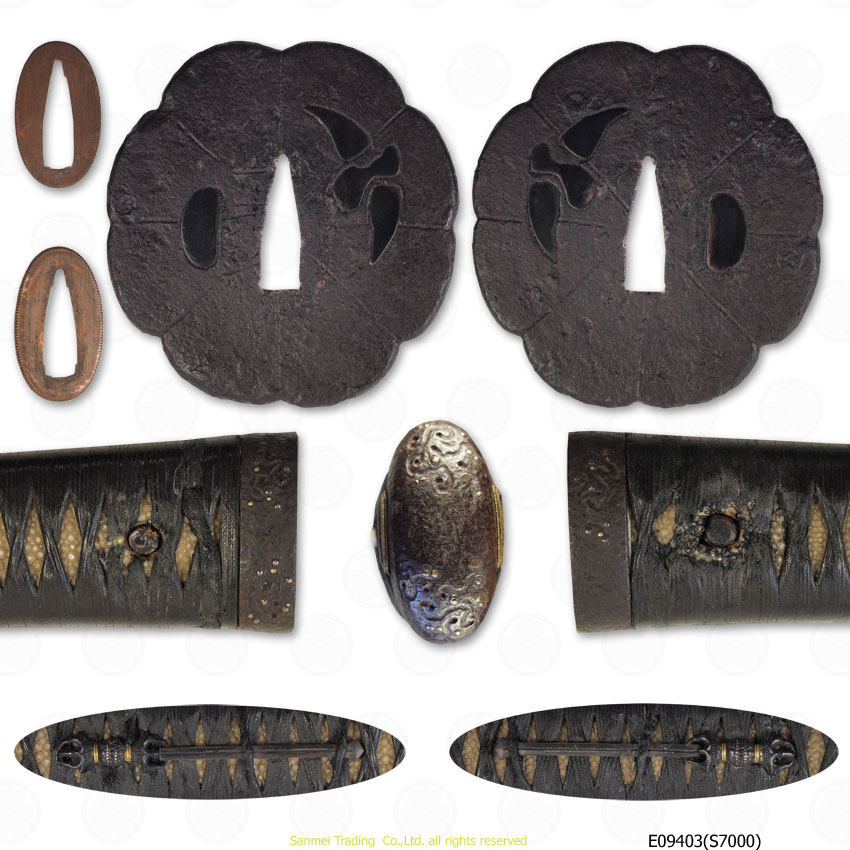
The blue pearl of inlay scabbard Uchigatana Koshirae consists of:
Wild goose motif Tsuba, Iron ground, octagonal Mokkou shape, filled by Shakudo (copper alloy), signed Yamakichi-bei.
Bug eaten motif Fuchi/Kashira, Iron ground, Silver/copper drop inlay.
Dokko(Buddhist altar fitting) Menuki, Shakudo ground Yobori carve, gold inlay.
Shakudo KOJIRI scabbard end.
White rayskin original black silk cord wrap hilt (cord got frayed and repaired)
(click HERE for high resolution of each metal work photograph)
Silver foiled single layer habaki collar, preserved in a Shira-Saya plain wood mounting.