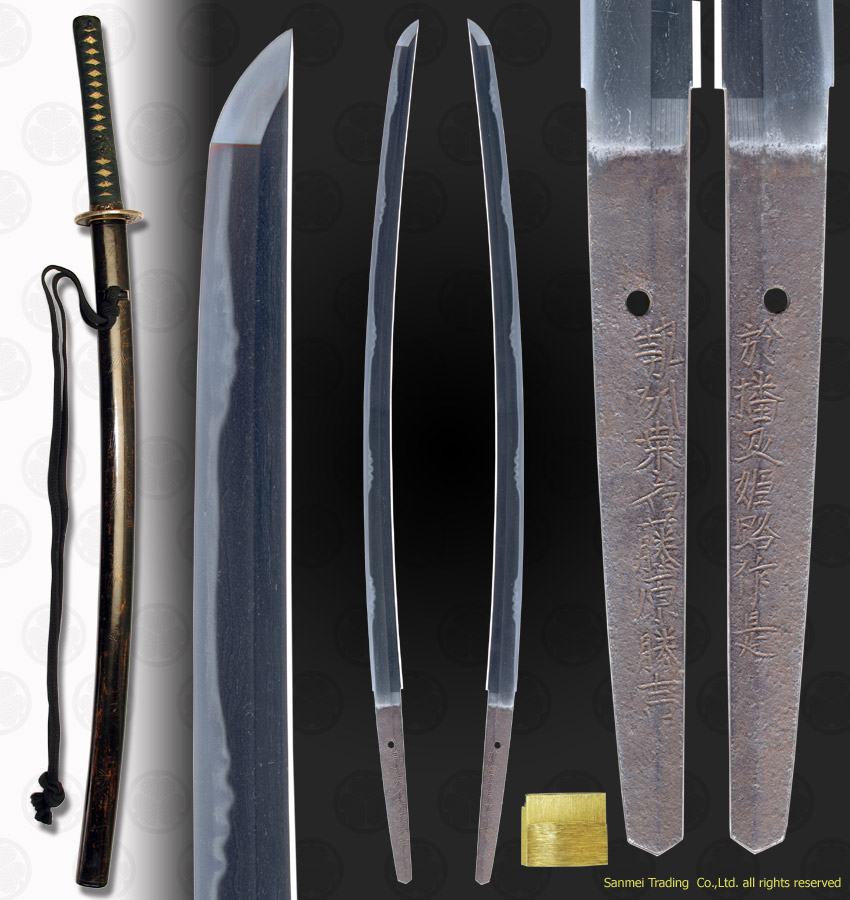
Bamboo grass pattern lacquered katana koshirae(set of mounts)
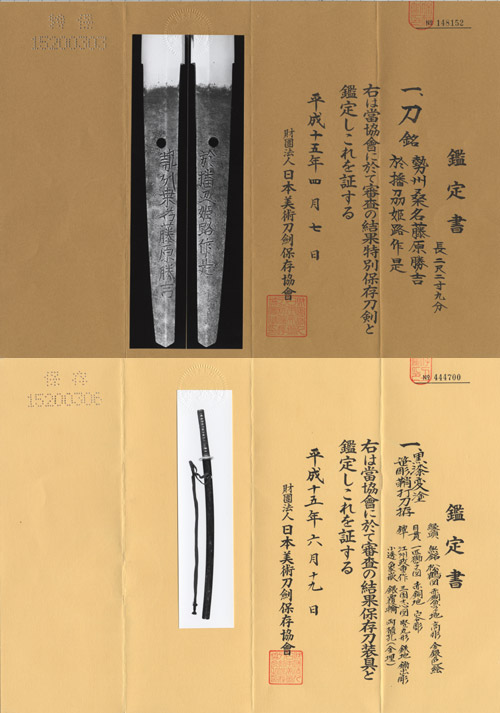
and HOZON TOUSOUGU
Length of cutting edge69.4cm Curvature1.8cm Width of base31.0mm Width of Yokote20.5mm Thickness of base7.2mm

Kitae(forging pattern) : Kitae is prominent itame(wooden grain) with some elements of Mokume-hada(burl grain), well kneaded with Ji-nie(hard metal granules over the surface of blade) and there is thick Chikei (thick nie lines).
Hamon(tempering pattern) : Hamon is Notare(wavy based), combination of large box shape gunome and wavy tempering pattern. a group of five small gunomes forms large box shape tempering pattern.Tempering pattern on both sides is well harmonized. The interior of temper is active with Ashi(lines projecting into the hardened edge) and sunagashi(thick lines of nie).
Boshi (tip): Tempering pattern in hakiomote is wavy(midarekomi) and deeply turned back and hakiura is midarekomi and medium circle turn back.
Nakago(tang) : UBU unaltered. O-sujikai yasurime(diagonal file marks descending to the right) kengyo(sharpened) heel. The signature on one side with thick chisel Seeshu Kuwana Fujiwara Katsuyoshi , marked on the other side with the place of forging Ban-shu Himeji ni-oite korewo Tsukuru.
The lineage of Muramasa in Senko school had been succeeded by Masashige on after Momoyama period and had been treasured by outside daimyos. Katsuyoshi is a pupil of Masashige and had moved from Kuwana to Himeji in his later period along with Honda Tadamasa feudal lord. The shape of this katana is decently curved, the shape of tang shows a major character of Senko family - The blade side is full and there is ko-niku(tiny mass) in the ridge side and Kengyo heel. The Entire Kitae-hada is calmly dignified, thick nie-lines swells. It is a famed work with healthy ji-ha. The tachi signed Seshu-kuwana-ju Fujiwara Katsuyoshi which had been dedicated to the Tado temple was nominated to the treasure of Mie-pref in the 54th year of Showa).
The bamboo grass pattern lacquered sheath koshirae comprising : Pine tree/crane motif shakudo nanako ground fuchi/kashira, Lion motif shakudo yobori menuki and iron tsuba Sangokushi motif, gold inlay and silver fukurin rim, signed Koshu-ju Masashige-saku.(click HERE for sets of mounts)
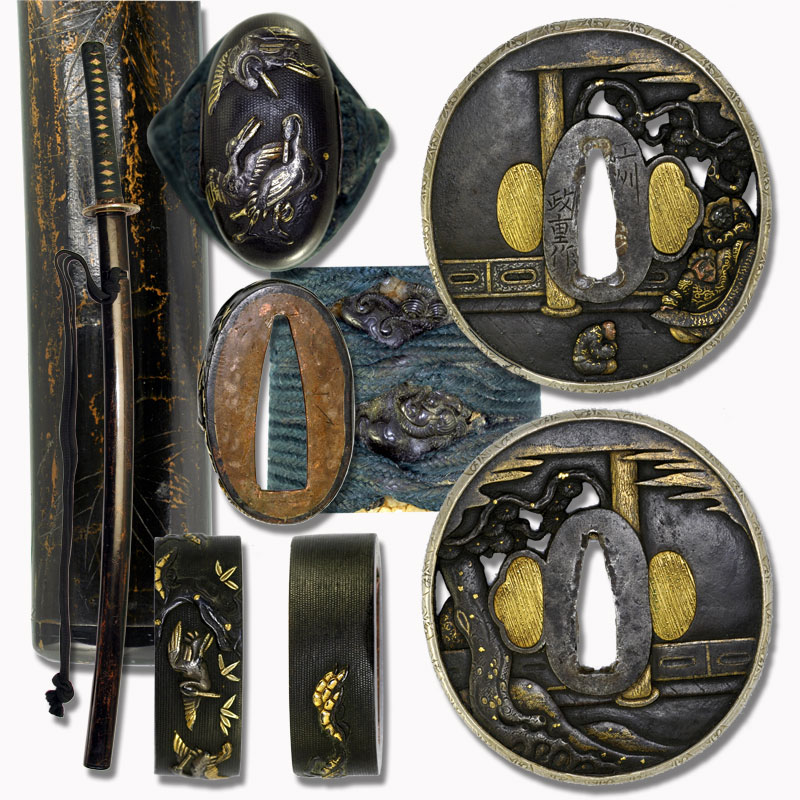
Gold foiled double habaki collar and shira-saya plain wood mounting included.