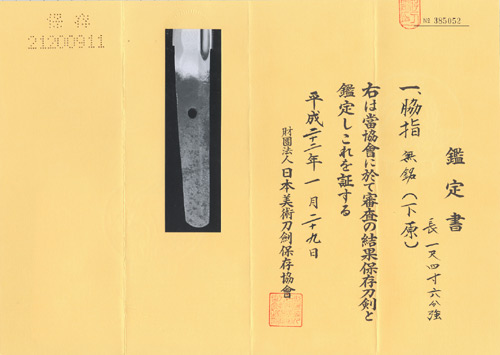
Length of cutting edge 44.3cm Curvature1.5cm Width of Base29.5mm Thickness of base6.0mm Width of Yokote19.9mm
Kitae(forging pattern) : Kitae-hada is conspicuous Itame wooden grain marks mixing in with large mokume burl, swirl so called AYASUGI-style hada-ware, along cutting edge, shows Masame straight grain marks. Outstanding forging marks generates from an abyss of steel and the steel surface shows darkish, moistened impression. The entire jigane forging mark is splendidly active with Itame large wooden grain marks generating an extremely beautiful scene of forging.
Hamon(tempering pattern) : Hamon is Nie based Gunome-zigzag, of which temper line is covered with thick and blight Nie granules, thick Nie lines blushing lines so called Kinsen or Sunagashi activity.The entire temper gives off vivid and strong light.
Boshi (tip): The temper of the tip waves like a blaze into small circle then turns back deeply.
Nakago(tang) : UBU un-altered, Shallow slanted left (Kattesagari) filemarks and round kurijiri heel. One mekugi-ana peg hole. Unsigned.
SHITAHARA lineage school, a frontier Yamamoto Tajima CHIKASHIGE who is a pupil of TSUNAHIRO in Odawara, was invited by a feudal loard Oishi to come to Shimo-ondaka, Bushu province (now in Hachiouji- city), during Eisho or Kyoroku (very early 16th century) period. On after Houjo had gone to ruin 18th Tensho (1590), SHITAHARA sword smiths had served for Tokugawa to flourish until end of Edo period. SHITAHARA swords lineage is a solitary instance in Bushu province. This wakizashi shows a typical character of Shitahara school, outstanding Itame, Mokume and some indication of Ayasugi forging scene plus hard Nie temper indication such as Kinsen or Sunagashi activity, which had been transmitted from Odawara Soushu school.
Silver foiled double layer Habaki (chrysanthemum flower pattern) collar. The entire blade is preserved in a shira-saya plain wood mounting.

