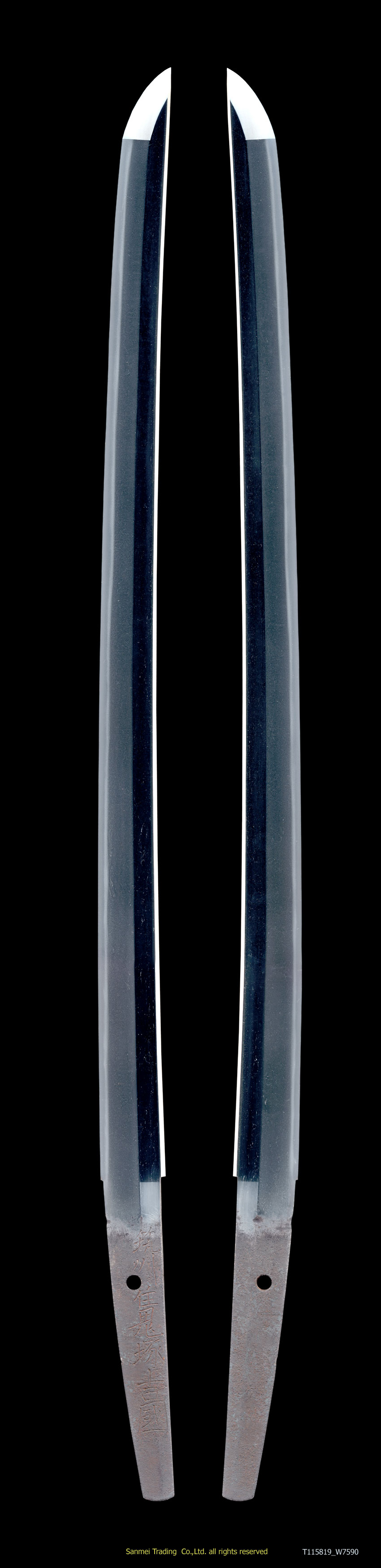
Length of cutting edge49.6cm Curvature0.7cm Width of base28.7mm Width of Yokote20.6mm Thickness of base6.2mm
Kitae(forging pattern): Kitae is Ko-mokume(fine wood grain) generally and mixing in flowing Masame straight mark along temper line in front. The entire jigane is thickly covered in rich Ji-nie (hard metal granules). Fine chikei small darkish nie lines glows over the surface.
Hamon(tempering pattern): Hamon is Suguha (broad straight temper line), a thick Nie sash, deep nioi-kuchi. There shows shallow wavy indication. There is frequent thick, short Nie feet glows toward the hardened cutting edge. The interior of temper is filled in rich Nioi-mist, bright and vivid.
Nakago(tang): Nakago is ubu(unaltered) original with Katte-sagari yasurime (shallow slanting left) file marks, one mekugi-ana, Kurijiri (round shape) heel, large signature on Sashiomote side is located right-hand side on shinogi-ji [Chiku-shu-ju Onizuka YOSHIKUKNI].
Boshi(tip): Bosi is straight with medium circle turns back orderly.
The first smith Onizuka YOSHIKUNI who was born in the 3rd year of Genki (1572), Tanagura, Oumi province (now in Tanagura town, Shirakawa-gun, Fukushima province). His swords had been very good at it's cutting performance ranks [WAZAMONO] from the List of Wazamono which was released in 1805 by Yamada Asaemon in the book Kaihōkenshaku (懐宝剣尺). Also his works are highly admired from the point of art object by Fujishiro Yoshio as [JOSAKU].
He was taken into the service of daimyo Tachibana Muneshige to come to Yanagawa, Chikugo province (now in Honjo town, Yanagawa city, Fukuoka prefecture). In the early Edo period, he supplied swords in great demand for the Shimabara Rebellion(1637-1638).
Silver habaki collar, preserved in Shira-Saya plain wood mounting.