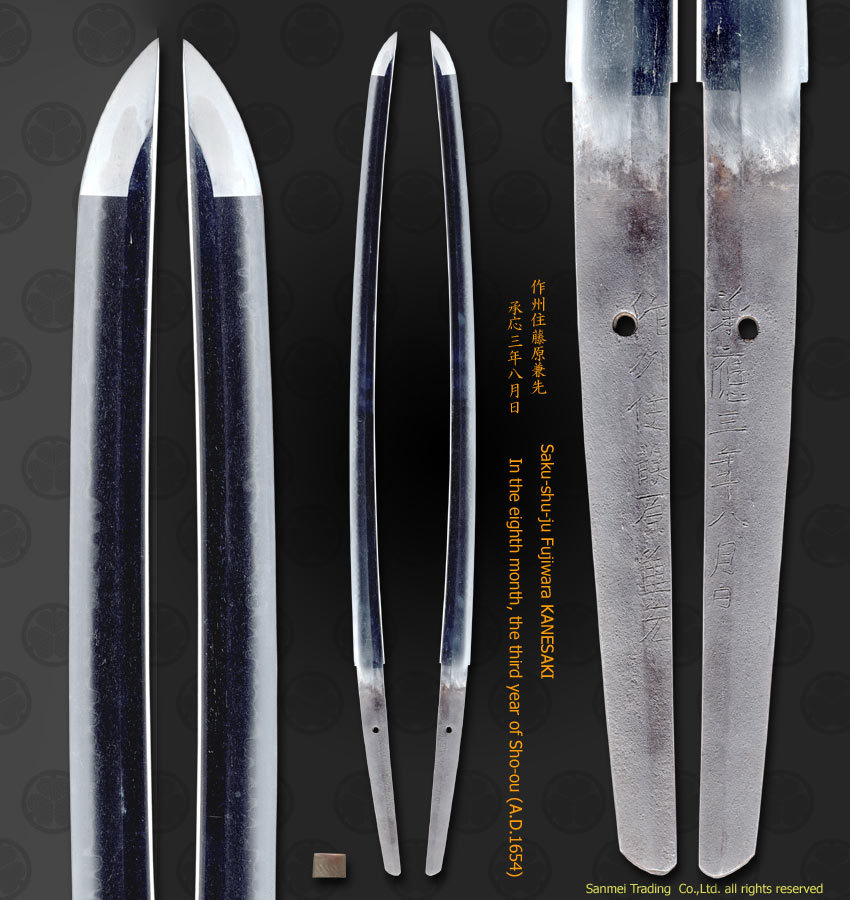
In the eighth month, the third year of Sho-ou

Length of cutting edge69.4cm Curve1.6cm Width of base32.6mm Thickness of base7.3mm Width of Yokote23.3mm
Kitae(forging pattern) : Kitae-hada is outstanding itame mixing in with Mokume (burl pattern) and shinogi-ji is entwined o-hada flowing masame(straight grained).
Hamon(tempering pattern) : Hamon, nioi based, starts with calm straight outline with small clove feet and a combination gunome-midare with tall choji midare (clove outlines) regularly repeated. Gunome feet works toward the cutting edge.
Boshi (tip): The temper of the tip in front is gunome irregularly and the reversed side begins with a gunome and straight medium circle turn back.
Nakago(tang) : UBU un-altered, Osujikai filemarks and IRIYAMA V-shape heel shape. One original mekugi-peg-hole. The signature in hakiomote is chiselled with large character located in shinogi-ji, the living of place (Sakushu-ju), Samurai family name (Fujiwara) and the smith name (KANESAKI) and the ura is the date of year, in the eighth month, the third year of Sho-ou i.e. A,D.1654.
Smith Kanesaki in Mimasaka province had been moved from Mino to Mimasaka in the early Momoyama period (early 17th century) and had established Mimasaka-Kanesaki families had succeeded in five generations. It is understood that this blade was made either by the first (Osada Hansuke) or second generation from it's date of year. The entire nioi-kuchi is tight and nioi based under Mino school but Bizen-favour can been seen as well. The entire blade is an old polish state which has been well-maintained, although there are some scratch marks and darkish stains here and there, all those wares are insignificant filled in with an old atmosphere and is good enough for appreciation or those wares can blow away in the next chance to have the blade sending to polish. The sword is entirely overflowing with an ambitious spirit with a brave Keicho-Shinto Style which had been popular during Momoyama period.
Copper habaki collar, comes in Shira-Saya plain wood mounting.