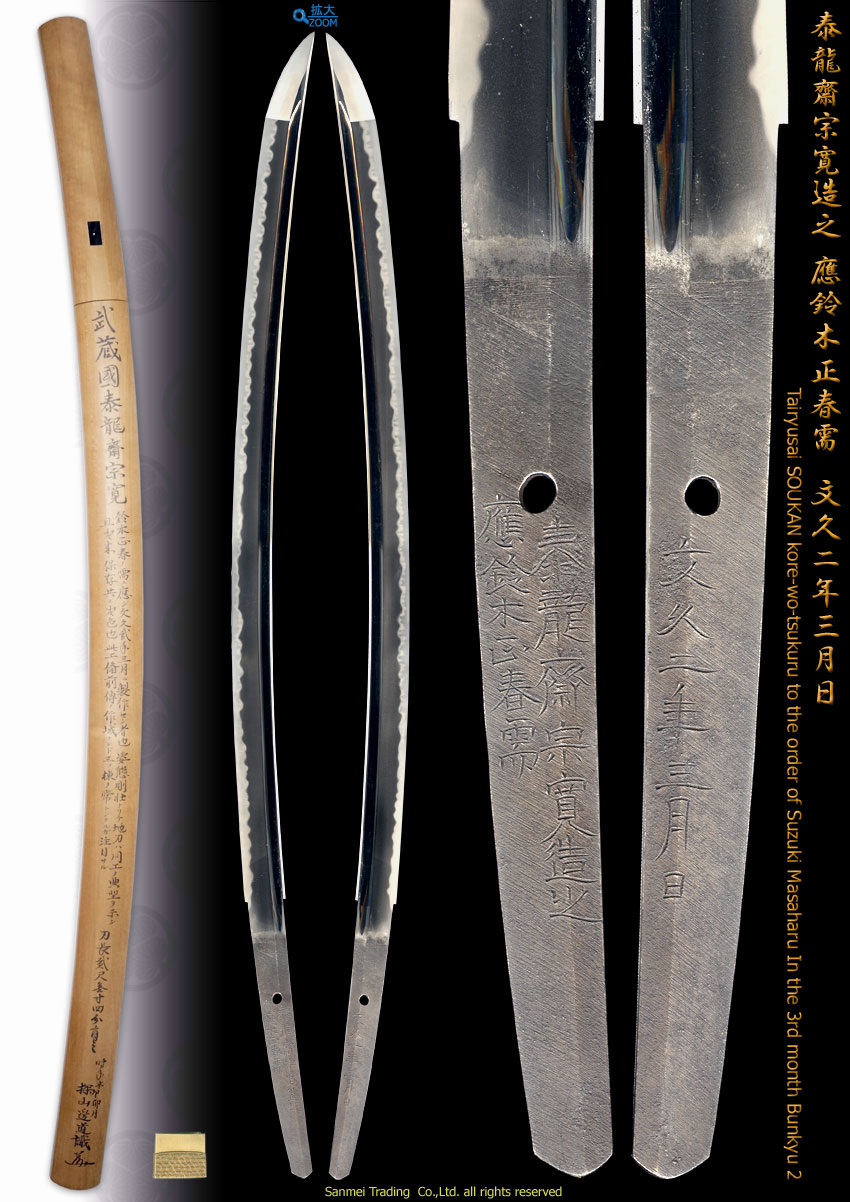
In the 3rd month Bunkyu 2
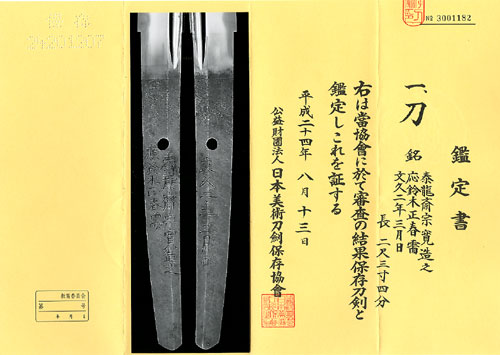
Length of cutting edge 71.0cm Curvature 2.1cm Width of base 33.2mm Width of Yokote 29.2mm Thickness of base 7.8mm
Forging(Hada): Forging is minutely forged Ko-Itame hada and the hiraji surface is covered with "Ji-nie" of sparkling hard metal granules where diffused reflection with a mottled effect "Midare-Utsuri" appears.
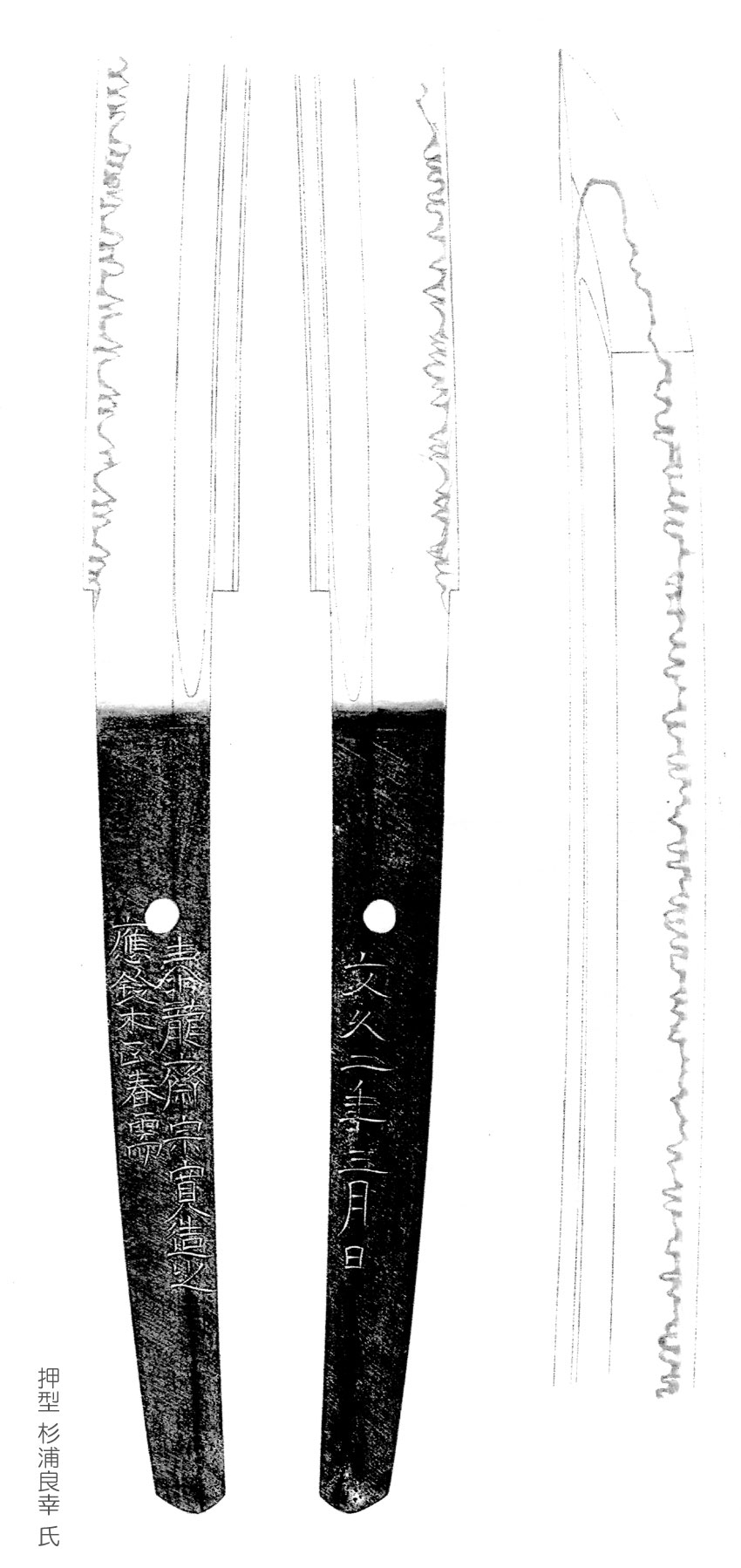
Temper(Hamon): Hamon is rather on strong side Ko-nie hard metal granules base, Choji of clove outline which varies in height and shape. The interior is filled with deep "Noi" mist-like crystalline area where clove feet splashes into the cutting edge frequently. The entire quench scene is vividly bright.
Temper of tip(Boshi): Boshi forms "MIDAREKOMI" irregular quench state with small circle turns back.
Tang(Nakago): Nakago is in UBU original, one peg hole. "Sujikai" (slanting left) filemarks with cosmetic horizontal filemark on upper Suridashi area so called "Kesho-Yasuri". Back ridge of Nakago is flat with "Sujikai" filemark. Bottom shape of heel is double bevelled (Kurijiri) in full. The signature in Hakiomite side is engraved on Shinogi-suji ridge, large chiselled inscription of "Tairyusai SOUKAN kore-wo-tsukuru 泰龍齋宗寛造之", custom-built inscription is chiseled on Hiraji-side "to the order of Suzuki Masaharu 應鈴木正春需". The other side chiselled with the date of year, "In the 3rd month Bunkyu 2 (1862) 文久二年三月日".
Smith SOUKAN 宗寛 was born on about 1818, early Bunsei era in Shirakawa, Oushu domain, now Shirakawa-city, Fukushima pref., as a son of Ouno Heizo 大野平蔵. He moved up to Bushu, Edo Tokyo on about Kaei 5 (1852) to become a pupil under the famed smith Koyama MUNETSUGU 固山宗次 and he later nominated him as an exclusive sword smith for a feudal lord Doi 土井 of Koga 古河 clan in Shimousa-han. He set his atelier at Hakozaki, Fukagawa town, Honjo, Edo (now Shirakawa town Koto-ku ward, Tokyo).
The initial smith name had started from a prefix of "Abukuma-gawa (O'kuma-gawa) river" of his hometown, turned the pseudonym of "Tairyusai 泰龍齋" in stead on about Ansei 1 (1854) and then changed his own unique "Rensho" writing style like this work on after 8th month of Ansei 4 (1857).
He is also renowned as a maker of the most supreme sharp cutting performance among all "Saijo O-waza-mono" like an example of cutting performance test by Iga NORISHIGE 伊賀乗重 who was the vassal of a chief retainer of Naruse in Owari-han, to show that "Cut off both the Moroguruma part of body and the skull 両車裁断其刃ニ而頭割" on Kaei 3 (1850).
The subject custom-made katana was forged for a retainer of Koga domain "Suzuki MASAHARU 鈴木正春" in 1862 when SOUKAN 宗寛 was mature 44 years old and outstandingly magnificent sword among his works.
Extra-large and solidly heavy sword was surely made under the social movement of an armed revolution right before the Meiji Restoration.
He seems free from convention that shows the fixed date of month like the 2nd or 8th month but chiseled the real month like this sword "3rd month".
Copper ground moss-engraving gold foiled double layer Habaki collar, preserved in Shira-saya plain wood mounting with Sayagaki written by Dr. Michihiro TANOBE.
reference data : Token Bijutsu vol.684, January 2014