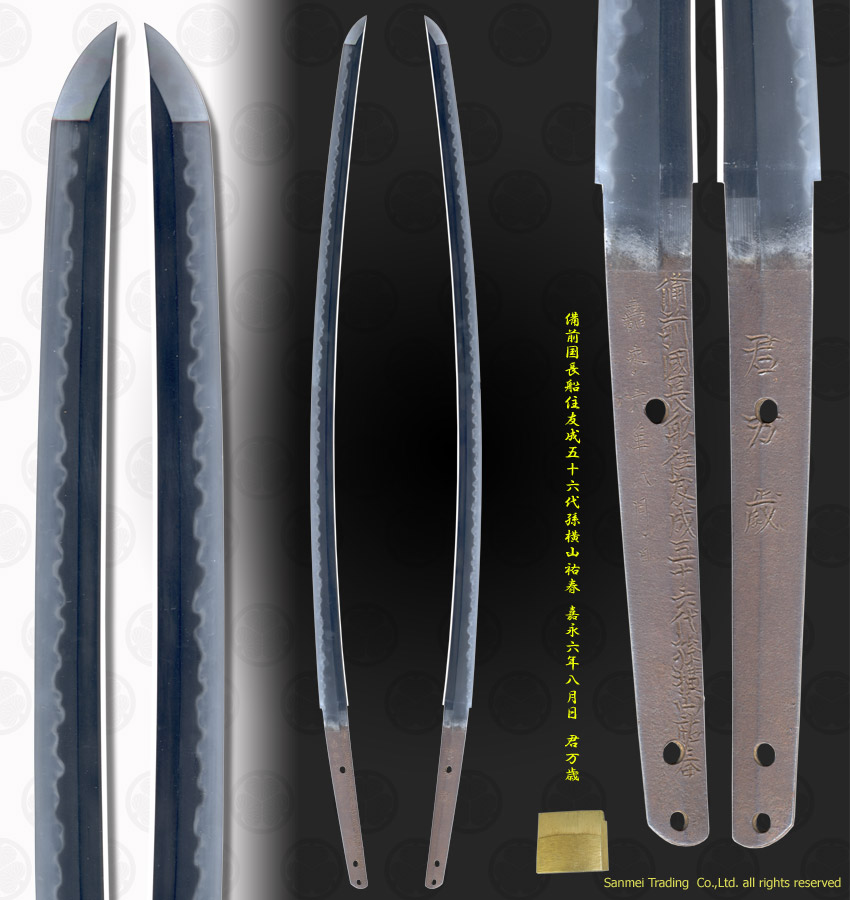
Length of cutting edge77.3cm Curvature2.7cm Width of base31.7mm Width of Yokote21.2mm Thickness of base7.4mm
Kitae(forging pattern) : Kitae is fine ko-itame (tight wooden grain). The entire steel is strongly forging.
Hamon(tempering pattern) : Hamon is ko-nie based a combination of gunome(zig-zag) and cho-ji (clove outline). Deep Nioi-ashi feet works toward the cutting edge.
Boshi (tip): Boshi is Midarekomi (wavy) small circle turn back.
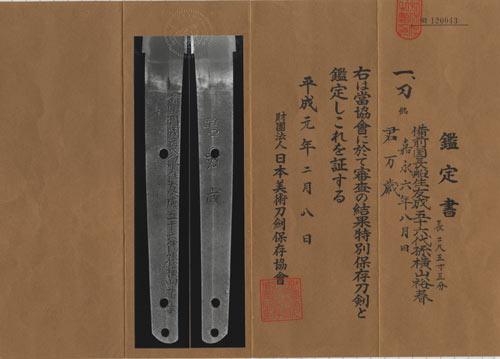
Nakago(tang) : UBU (unaltered) three Mekugi-ana (retaining holes). Kattesagari file marks. Ha-agari kurijiri heel shape. The signature is located a upper, shinogi-ji, thick chiselled long character that reads Bizen koku Osafune Tomonari Fifty-sixth descendant of Tomonari Yokoyama SUKEHARU, the eighth month, six year of Kaei and Ura is chiselled large three character that means Long Live the Emperor.
The length of cutting edge is as long as two shaku three sun and five bu. The tang is curved, a combination of Koshizori and middle pointed curve that creates a graceful Tachi style. The kasane is thick, width of shinogi-ji is narrow and mass of hiraniku is less, these are major identification of Shin-shinto katana during end of Edo period. Sukeharu in Bizen province was descended in a direct line from Tomonari and because of owner's strong intention, there chiselled in hakiura [Kimi Banzai]
Gold foiled double layer habaki and Shira-Saya plain wood mounting.